How to Set Up a Grow Light for Indoor Basil
Using a grow light for basil indoors is one of the smartest moves any home cook or herb enthusiast can make. Basil craves intense, consistent light — roughly 6 to 8 hours of direct sun per day — and most kitchens simply can’t deliver that year-round. A dedicated grow light fills that gap perfectly, keeping leaves large, fragrant, and productive whether it’s the height of summer or the dead of winter. This guide walks you through every step, from choosing the right fixture to dialing in the perfect daily schedule.
Table of Contents
What You’ll Need
- A full-spectrum LED or fluorescent grow light (more on choosing one in Step 2)
- A sturdy pot with drainage holes, at least 6 inches deep
- Well-draining potting mix — a standard herb or vegetable blend works well
- Basil seeds or an established seedling
- A plug-in outlet timer (mechanical or digital)
- A ruler or tape measure for checking light distance
- A small fan (optional but helpful for air circulation)
- Liquid fertilizer formulated for leafy herbs
Step 1: Understand Why Basil Needs Supplemental Light
Before you invest in a grow light for basil indoors, it helps to understand what you’re solving. Basil is a sun-hungry Mediterranean herb. In its native environment it receives intense, unfiltered sunlight for the better part of the day. A typical north- or east-facing windowsill might provide 2 to 3 hours of usable light — well below the threshold basil needs to thrive.
The result of insufficient light is painfully obvious: stems stretch upward and go leggy, leaves shrink and lose their deep green colour, and the plant drops leaves quickly. You end up with a scraggly plant that barely produces enough for a single pasta dish. A proper grow light for basil indoors solves all of that by replicating the spectrum and intensity of outdoor sun, right on your countertop or shelf.
Even a south-facing window can become unreliable in autumn and winter, when daylight hours shrink and the sun sits low on the horizon. That’s when a grow light for basil indoors goes from a nice extra to a genuine necessity.
Step 2: Choose the Right Grow Light for Basil Indoors
Not all grow lights are equal, and picking the wrong one is the fastest way to waste money. For a grow light for basil indoors, you have three main options: full-spectrum LED panels, compact fluorescent lamps (CFLs), and T5 fluorescent tubes. Each has real-world trade-offs.
| Light Type | Energy Use | Heat Output | Best For |
|---|---|---|---|
| Full-Spectrum LED Panel | Low | Very low | Single pot to small shelf garden |
| T5 Fluorescent Tube | Medium | Low | Long windowsill or multiple pots in a row |
| CFL Bulb | Low–Medium | Moderate | Single pot, tight budget |
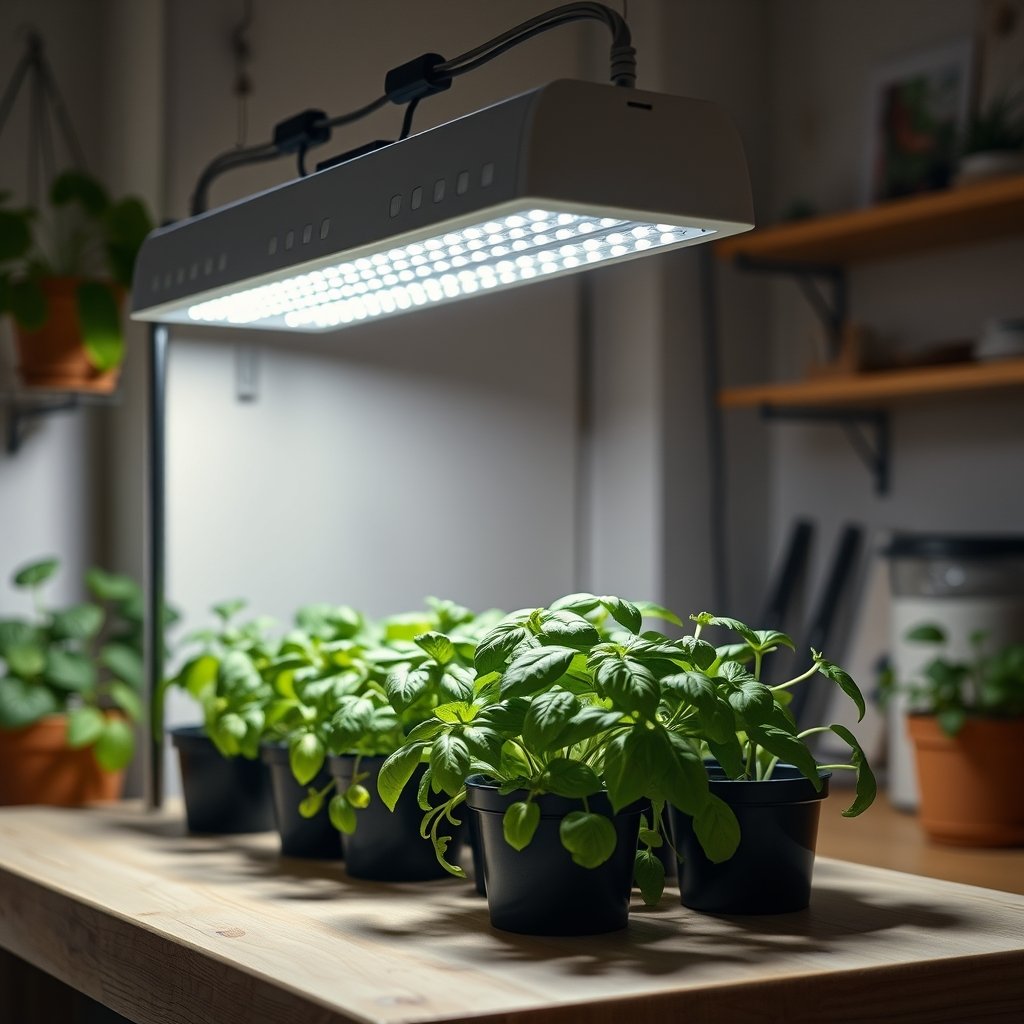
We recommend a full-spectrum LED panel for most home growers. It runs cool, consumes less electricity than fluorescents, and modern panels include both blue wavelengths (for leaf growth) and red wavelengths (for flowering and fruiting). When shopping for a grow light for basil indoors, look for a unit rated at 2000–4000 lumens for a single pot, or 6000–10000 lumens if you plan to grow a small shelf garden of mixed herbs. Check the label for a colour rendering index (CRI) of 90 or above — that broad spectrum keeps basil producing lush, flavourful leaves rather than just surviving.
Avoid cheap “blurple” lights (purple-tinted LED strips that emit only red and blue). They work, but full-spectrum white LEDs produce more balanced growth and are far easier on your eyes when you’re working in the kitchen.
Step 3: Set Up Your Growing Space
A great grow light for basil indoors still needs a smart home. Pick a spot that’s stable in temperature — basil hates cold drafts and anything below 60°F (15°C) will stunt growth quickly. A kitchen counter away from the refrigerator vent, a windowsill shelf, or a dedicated tiered plant stand all work well.
Mount or position the light directly above the plant. Most LED panels come with an adjustable hanging cable or a gooseneck arm; make sure whichever fixture you choose can be raised as the plant grows. Also think about spill light — LEDs are bright, and having one pointed at eye level across the room gets annoying fast. A simple reflective surface behind the pot (even white cardboard) bounces light back toward the plant and reduces waste.
Good air circulation matters too. Stagnant air encourages fungal issues like downy mildew, which is particularly common on indoor basil. A small USB fan set to low, running a few hours a day, makes a real difference. It also gently stresses the stems, making the plant stockier and sturdier — which is exactly what you want from an indoor herb.
Step 4: Position the Light at the Correct Distance
Distance is the most underestimated variable when you use a grow light for basil indoors. Too close and you’ll bleach or burn the leaves; too far and the plant doesn’t receive enough intensity to grow well. The right distance depends on the wattage and design of your specific light, but general guidelines give you a solid starting point.
For a typical LED panel in the 20–45 watt range, position it 6 to 12 inches above the top of the plant. For a T5 tube, 4 to 6 inches is usually ideal. CFL bulbs work best at 3 to 5 inches because their output drops off sharply with distance.
Here’s a practical test: hold your hand flat just above the leaves under the light for 30 seconds. If it feels uncomfortably warm, raise the fixture a couple of inches. If you feel almost nothing, lower it slightly. Adjust incrementally and observe the plant over a few days — new leaves that emerge wide, flat, and deep green tell you you’ve found the sweet spot. A grow light for basil indoors that’s correctly positioned is immediately visible in the quality of new growth.
Step 5: Set a Consistent Daily Light Schedule
Consistency is everything when you’re relying on a grow light for basil indoors. Basil performs best with 14 to 16 hours of light per day under artificial conditions. That might sound like a lot, but remember — indoor grow lights are always less intense than direct sunlight, so a longer photoperiod compensates for lower intensity.
A plug-in outlet timer is your best friend here. Set it to turn the light on at the same time every morning and off at the same time every evening. This eliminates the most common beginner mistake: forgetting to turn the light on or off, which stresses the plant and disrupts its internal rhythm.
Avoid running the light 24 hours a day. Plants need a dark period for metabolic rest and to carry out cellular repair. Running lights around the clock can actually slow growth and make leaves taste more bitter. A grow light for basil indoors used on a disciplined 14–16 hour cycle almost always outperforms one left on continuously. According to the University of Maryland Extension, consistent light cycles are one of the most impactful factors in successful indoor herb growing.
Step 6: Water and Feed Your Basil Correctly Under Grow Lights
Running a grow light for basil indoors changes your plant’s water and nutrient demands in ways that catch new growers off guard. Grow lights, even cool-running LEDs, slightly increase the evaporation rate from both the soil and the leaves. This means your basil will likely need watering more frequently than a plant sitting on a windowsill with no supplemental light.
Check the soil every day by pressing a finger about an inch into the potting mix. Water thoroughly when the top inch feels dry, then let the pot drain fully. Never let basil sit in standing water — the roots will rot surprisingly quickly. Use room-temperature water; cold water shocks the roots and can cause leaf drop overnight.
Feeding is equally important. Under a grow light for basil indoors, your basil is actively photosynthesising for up to 16 hours a day, which means it burns through nutrients faster than a plant in a garden. Use a balanced liquid fertilizer (look for roughly equal N-P-K numbers, such as 10-10-10 or a dedicated herb fertilizer) at half the recommended dose, applied every two weeks. The Royal Horticultural Society recommends feeding leafy herbs little and often rather than in large, infrequent doses — a principle that applies perfectly here.
One more thing: don’t skip pruning. Pinch off flower buds the moment you see them. Once basil flowers, it puts energy into seed production and the leaves lose flavour quickly. Regular harvesting — snipping stems just above a leaf node — actually encourages the plant to branch out and produce more leaves, which compounds the benefit of your grow light for basil indoors setup.
Step 7: Troubleshoot Common Grow Light Problems
Even with the best setup, you’ll occasionally run into issues. Knowing what to look for makes a grow light for basil indoors setup far less frustrating to maintain.
Yellowing lower leaves: Usually a sign of overwatering or nutrient deficiency, not a lighting problem. Check your watering frequency first, then consider a light fertilizer dose.
Bleached or papery white patches on the upper leaves: This is light burn. Your fixture is too close. Raise it by 2 to 3 inches and the new growth should come in healthy.
Leggy, elongated stems reaching toward the light: Your light is too far away or too dim. Lower the fixture, switch to a higher-output model, or extend the daily light schedule by an hour or two.
Brown, crispy leaf tips: Often caused by low humidity combined with warm air from the light. Place a small tray of water near the plant or run a pebble tray with water beneath the pot to boost local humidity.
Slow growth despite good light: Check temperature and root space. A pot that’s too small restricts growth even when a grow light for basil indoors is working perfectly. Transplant to a larger container and you’ll often see a growth surge within a week. The Gardening Know How guide on indoor basil covers additional environmental factors that influence growth speed.
Common Mistakes to Avoid
- Skipping a timer: Manual switching leads to inconsistent light cycles, which stresses the plant and reduces yields. A timer costs very little and pays for itself immediately.
- Using too weak a light: A decorative LED clip-on lamp or a standard desk bulb is not a grow light for basil indoors. Look for units specifically marketed for plant growth with documented lumen and spectrum output.
- Never adjusting light height as the plant grows: A seedling needs the light closer; a mature plant grows upward and can end up burning its new tips if you never raise the fixture.
- Overwatering under the assumption that light dries soil instantly: Yes, grow lights increase evaporation slightly, but the soil still needs to approach dryness before you water again. Daily finger-testing beats guessing.
- Letting the plant flower without intervention: Flowering ends the productive life of a basil plant faster than almost anything else. Pinch those buds religiously.
- Ignoring air circulation: A stuffy indoor environment under grow lights is a perfect breeding ground for pests like aphids and fungal problems like grey mould. A small fan is cheap insurance.
- Buying a light sized for a large grow tent for a single pot: Oversized, high-wattage lights produce far more heat and intensity than a small container of basil can handle. Match the light’s coverage area to your actual growing space.
Final Thoughts
Getting a grow light for basil indoors right isn’t complicated — it just takes a little upfront planning. Choose a full-spectrum LED matched to your space, hang it at the correct distance, run it on a reliable timer for 14 to 16 hours daily, and pair that light with consistent watering and feeding. Do those things and you’ll have a bushy, fragrant, productive basil plant that performs through every month of the year, no sunny windowsill required.
The payoff is real: fresh basil on demand for pasta sauces, pesto, salads, and cocktails, grown 12 inches from your stovetop. Once you see how quickly a well-lit plant bounces back from a heavy harvest, you’ll wonder why you relied on supermarket packets for so long. A grow light for basil indoors is one of those small investments that genuinely improves daily life in the kitchen.
If you enjoy optimising your home workspace and living spaces, you might also find our guide to the best standing desk for small spaces useful — the same principle of making the most of limited square footage applies whether you’re growing herbs or working from home. And if you’re building out a home office alongside your herb garden, our best robot vacuum for pet hair roundup can help keep that space clean without any extra effort.
Keep experimenting with your grow light for basil indoors setup. Every kitchen is slightly different — different ambient temperatures, humidity levels, and air flows — so treat the guidelines here as a starting framework, not a rigid prescription. Observe your plant, adjust one variable at a time, and let the basil tell you what it needs.
Frequently Asked Questions
How many hours a day should a grow light for basil indoors be on?
Most home growers get the best results running a grow light for basil indoors for 14 to 16 hours per day. This longer photoperiod compensates for the lower intensity of artificial light compared to direct outdoor sunlight. Always include a dark period of at least 8 hours — basil needs rest just like any other plant.
Can I use any LED bulb as a grow light for basil indoors?
A standard LED household bulb isn’t an effective grow light for basil indoors. Regular bulbs are designed to look bright to the human eye, not to deliver the specific wavelengths and intensity that plants use for photosynthesis. Look for lights explicitly labelled as full-spectrum grow lights with documented lumen output and a broad colour spectrum including blue (around 450 nm) and red (around 660 nm) wavelengths.
How far should a grow light be from basil?
The ideal distance depends on the fixture type. For a standard 20–45 watt LED panel used as a grow light for basil indoors, position it 6 to 12 inches above the top of the plant. T5 fluorescent tubes can sit 4 to 6 inches away. Always observe the leaves for signs of light burn (bleaching) or light hunger (leggy stretching) and adjust accordingly.
Will a grow light for basil indoors work in winter?
Absolutely — that’s one of its best qualities. A grow light for basil indoors provides consistent, controllable light regardless of the season, making it perfect for year-round herb growing. The only winter-specific adjustment you may need to make is temperature: keep your basil away from cold windowpanes and drafty areas, as basil suffers below 60°F (15°C) even with perfect lighting.